
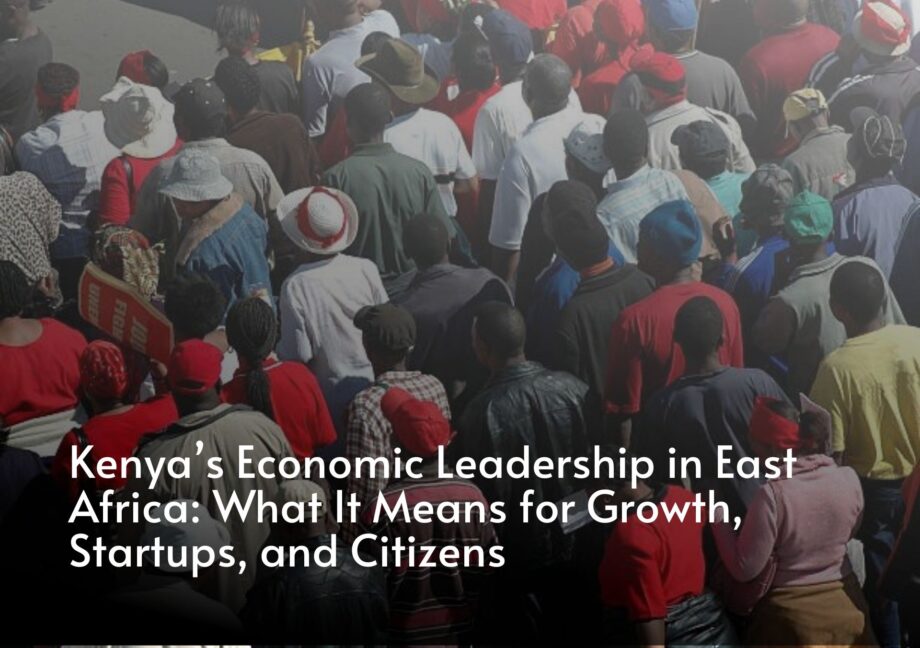
IMF forecasts indicate that Kenya will be the biggest economy of the East African Community in 2026 and it will have a GDP of USD 140.87 billion. This puts Kenya on top of Tanzania (USD 95.35B) and the Democratic Republic of Congo (USD 88.13B) to strengthen its position as an economic anchor of the region. Research wise, this expansion is indicative of long-term investments in infrastructure, financial services, regional trade and human capital. Nonetheless, the macroeconomic size is not sufficient to measure the distribution of growth or the resilience of households and firms to economic shocks – in both cases where rigorous efforts of data collection and impact analysis are required.
A bigger economy increases the market size, enhances confidence to investors and more entrepreneurship prospects. It already boasts more than forty percent of the venture capital activity in East Africa, with a greater proportion in fintech, agri-tech, health-tech and climate innovation. It has been observed that startups perform well in situations where demand is quantifiable, customers are known, and regulatory frameworks are evidence-based. The use of market research, feasibility analysis and customer insight surveys can help an entrepreneur to plan products that are within their affordability ranges, demand trends of the region and the usage habits. An opportunity is created by the growth of GDP, and data is employed to guarantee sustainability and scalability.
Growth in the economy provides room in which people get jobs, earn incomes and better services. The unemployment rate in Kenya is still high above 5% and youth unemployment is also even more so as a result, inclusive growth is an agency. Research is very important to determine the impacts of economic growth on livelihoods, household resilience, food security, and access to basic services. Baseline and endline surveys, poverty tests and labor government reports and studies are useful in establishing whether growth is reaching the informal workers, rural populations, women and vulnerable people.
Evidence will make sure that policy responses are focused and just as opposed to generalization.
The economic leadership of Kenya empowers its position in the regional trade negotiations, infrastructure corridors and mobilization of public finance. Nevertheless, sustainability of the public debt, efficiency of service delivery, and fiscal responsibility are still the main challenges. The benefits of data-driven policymaking are that it enables governments to review reforms, manage resources efficiently, and quantify outcomes over outputs. Monitoring, evaluation and learning (MEAL) frameworks also offer governments and development partners evidence in real-time on what works, what scales, and what requires redesign.
To investors and development partners, the size of Kenya as a country is an indication of a stable market and the possibility of growth in the long term. However sustainable investment goes beyond the macroeconomic projections. Research is helpful in risk evaluation, social measurement of impact and regulatory alignment. The research demonstrates that evidence-based planning and community-informed data projects are more likely to succeed in the development results and be commercially viable.
Kenya is the largest economy in East Africa and this aspect provides strong opportunities to innovate, grow the enterprise and impact the region.
Nevertheless, inclusive prosperity cannot be achieved only through economic growth. Research turns growth into impact through national indicator translations into household outcomes, business insights as well as policy effectiveness. Since Kenya still has its positive economic trend, evidence-based decision-making will be a key factor in making sure that positive changes are quantifiable, participatory, and sustainable within the sector and societies.
The comparison with other East African countries was interesting. Looking forward to seeing how the region develops over the next few years.
I like that the article talks about inclusive growth. Development should reach every part of the country.
As a small business owner, I agree that understanding customers matters more than assuming what they want. Good insights.
This explains things in a simple way. I never thought about how research connects with economic planning before.
Growth is good, but data is what helps leaders know where the biggest gaps still exist. Nice article.
I enjoyed reading this. The part about using research to guide investment decisions really stood out for me.
Interesting perspective. Most people only focus on GDP, but the real question is whether everyday Kenyans are actually feeling the benefits.
I enjoyed this article. It explains why looking beyond GDP figures is important when talking about development.
The startup angle caught my attention. Growth creates opportunities, but understanding what customers actually need is what helps businesses survive. Nice article.
Good points here. Kenya has a lot of potential, but the real test is whether growth reaches ordinary households. Looking beyond the headline numbers makes this article worth reading.
Excellent perspective. Kenya’s projected economic leadership presents significant opportunities, but the emphasis on evidence-based decision-making is what truly stands out. GDP growth is most meaningful when it translates into improved livelihoods, stronger businesses, and inclusive development. Continuous research, monitoring, and impact evaluation will be essential to ensure that economic progress benefits all Kenyans, not just key sectors of the economy.
Interesting perspective. Kenya’s economy may be growing, but measuring the impact on people’s daily lives is just as important as the numbers themselves.